


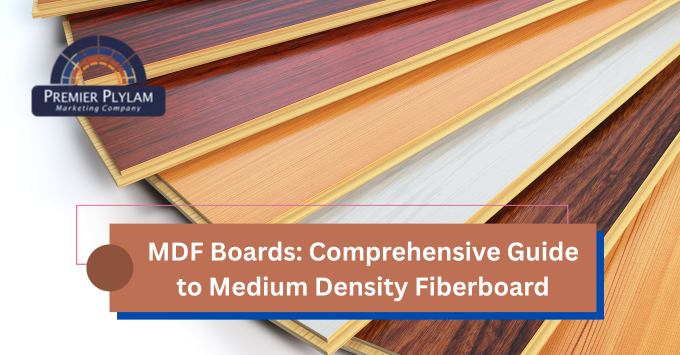
MDF boards: The complete guide to medium-density fibreboard
Some of the positive qualities of MDF boards have led to their widespread application within the furniture and interior decoration industries today. Their aesthetics, structural stability, and low cost make them the best option for present-day homes and professionals.
The MDF has kept pace with this change in trends of design, such as cleanness, simplicity and imperceptible finishes, and its demand has never been stronger.
A Beginner’s Guide to MDF Boards: Medium-density Fibreboard
MDF boards have grown in popularity very quickly due to the fact that they are very strong, uniform in every aspect, and smooth, which is a property that natural wood cannot provide all the time. They consist of very small tree fibres that are glued together with the help of resin, and thus the end product is always of a consistent quality without knots or visible grain. Designers are being given more freedom to come up with elegant and futuristic pieces.
MDF is often found in residential, business, and retail areas because it lasts longer in indoor settings, which are also the most controlled environments. Its capability of being coated by different paints and veneers makes it perfect for usage in decorative works.
Made of MDF Boards: MDF manufacturing.
The process of MDF manufacturing is one where wood leftovers are transformed into compact and sturdy sheets, and by so doing, waste is reduced, and a material that is both practically and ecologically efficient is produced.
A brief outline of the production process
- Wood Collection: from sawmills, the wood chips and waste are collected.
- Fibre Separation: the chips are boiled and reduced to fine fibres.
- Resin and Wax: the fibres are combined with resin to make them strong and with wax to make them waterproof.
- High-Pressure Pressing: Under strong heat and pressure, the mixture is pressed to obtain fibre panels of high density.
- Cooling & Trimming: Cooling & Trimming: The panels are then cooled and cut into different sizes.
- Sanding: Both surfaces are sanded down to receive a smooth and uniform finish.
Trending fact:
In the production of materials, factories have now moved on to the use of low-emission resins, which not only make the material safer but also align with the global preference for healthier and eco-friendly products.
Advantages of Using MDF Boards
There are many reasons why MDF boards are trusted in carpentry and interior design.
Main benefits
- Flat Surface: It is suitable to paint, laminate or veneer.
- Low-Cost: cheaper than plywood and solid wood.
- No Grain Issues: No knots or cracks like natural wood.
- Easy Machining: Cuts, shapes, and joins easily with tools.
- Perfect for Designs: Great for carved patterns and CNC work.
- Uniform Strength: Consistent density across the material.
Why experts prefer it
Modern design is done with the help of interior designers, such as carpenters, who find it easy to shape. It particularly applies well to furniture that requires a finish of polish or painting.
Common Applications of MDF Boards: MDF applications
The range of MDF applications is wide because this material can be shaped and finished in many ways.
Where MDF-style fibreboard sheets are commonly used
- Kitchen Cabinets: Clean-looking, smooth panels.
- Wardrobes: Sliding and hinged designs.
- Shelves: Auger reel failed rules for migrants: Great at shelf walls and shelves.
- Wall Decor: It is effective in the decoration of wall panels and contemporary 3D types.
- Home Furniture: These are used in beds and dressers, study tables, and TV units.
- Doors: Can be used on interior door frames and doors.
- Trims & Mouldings: Good to use in baseboards, cornices, and window dressing.
The Trendiest Thing
CNC-moulded panels made out of engineered wood sheets are taking over interior decor, and living rooms and even office walls are opting for them.
Wood Panels Comparison: MDF vs Plywood
MDF and plywood are the two materials that are always competing whenever it comes to utilising wood-based materials. All have their merits, but it depends on the individual project.
Main points to comprehend
- MDF gives a very fine surface, while plywood shows the grain.
- Plywood is the material of choice for places with moisture, while fibreboard is excellent for designs indoors.
- MDF is the most affordable of all, and so it is the choice one would undertake to make economic furniture.
- The most suitable one to carve and paint is engineered wood.
- Plywood would be the choice for durability and strength.
When to select MDF-like boards
When you need crisp-edged painted finishes for your indoor furniture or wall decoration, then go for MDF-like boards.
Situations When Plywood is the Best Choice
Take plywood for use in open-air or semi-open areas that are usually highly moisture-laden, since the wood is less resistant to such conditions.
Working with MDF Boards: Handy Tips
When the right procedure is followed in the use of medium-density fibreboard, it produces a durable product.
Recommended Suggestions
- Use sharp blades: This will prevent chipping while cutting.
- Prime the edges: Edges absorb paint, so it’s necessary to seal them.
- No water: Keep moisture away to avoid swelling.
- Always wear a mask: The dust is too fine, so it is necessary to protect yourself.
- Pre-drill holes so that the material does not break.
- Lifting should be done gently: the boards are heavier than other sheet materials.
Pro Tip
Waterproof MDF is the most commonly used material by professionals now for kitchens and bathrooms. It can be exposed to steam and water splashes, but the perfect surface remains.
Environmental Impact and Sustainability of MDF Boards
The modern consumer and MDF as a sustainable wood product often depend on the environmental aspects of the production process.
Why engineered wood panels are considered sustainable
- Uses recycled wood: Made from leftover fibres, not from fresh trees.
- Reduces waste: The whole wood resource is used to the maximum.
- Energy-saving manufacturing: contemporary technology makes emissions come down.
- Long life span: Takes a long time when in dry conditions.
Concerns to consider
Some resins may produce toxic gases; however, today’s producers are making low-formaldehyde and E0 MDF, which are home-friendly.
Growing trend
Indeed, fibreboard sheets made out of resin, which is a plant material, are becoming popular. These inventions are likely to determine the pattern of eco-friendly interiors.
Conclusion
MDF boards have become one of the important materials in modern furniture and interior design. Their smoothness, uniform strength and affordability have made them highly appealing for residential, office and commercial use. Besides, they can be cut, shaped, painted, and finished so easily, thus being suitable in cool and contemporary interiors. The new water-resistant MDF will address this issue, as it is not suited to humid locations.
MDF is a convenient and appealing alternative when it comes to designing clothes (or a wardrobe), furnishing a shelf, wall panels, custom furniture or just about anything. The engineered wood panels will remain an intelligent and trustworthy option since the trends shift towards clean finishes and environmentally friendly materials.