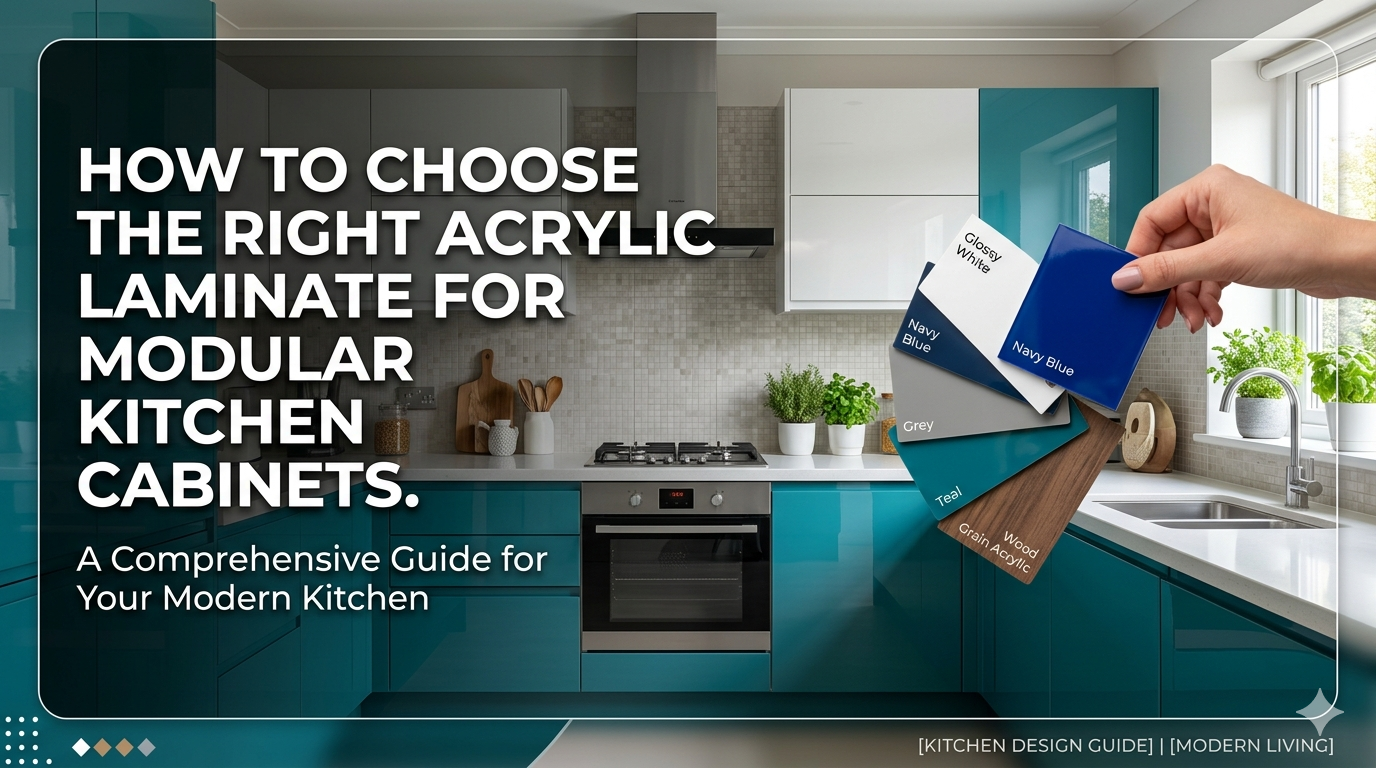
Walk into any modern Indian home and chances are the kitchen shutters gleaming back at you are finished in acrylic laminate. There is a good reason for that — these laminates deliver the premium, high-gloss look of lacquered cabinetry at a fraction of the cost, and they are far more forgiving to install and maintain than solid wood or painted finishes.
But choosing the wrong acrylic laminate is a mistake that homeowners — and even experienced contractors — make surprisingly often. The wrong thickness chips. The wrong finish shows every fingerprint. The wrong brand fades within two years in Rajasthan’s harsh summer sun. The wrong colour makes a compact Indian kitchen feel even smaller.
This guide, written by the interior materials experts at Premier Plylam Marketing Company, Jaipur, gives you everything you need to make a confident, informed choice — covering finish types, thickness options, substrate compatibility, colour selection, brand quality, and the questions every buyer should ask before placing an order.
1. What Is an Acrylic Laminate?
Acrylic laminate is a decorative surface sheet made from acrylic polymer layers bonded together and finished with a highly reflective or textured surface coating. Unlike standard high-pressure laminates (HPL) — which are made from paper and resin — these laminates are manufactured from thermoplastic acrylic sheets that offer superior depth of colour, surface clarity, and light reflectance.
When applied to the shutter boards of modular kitchen cabinets, it creates a mirror-like or soft-gloss finish that makes kitchens look larger, brighter, and significantly more premium than the material cost would suggest.
Acrylic laminate vs standard HPL laminate — key differences
| Property | Acrylic Laminate | Standard HPL Laminate |
| Surface finish | High gloss / soft gloss / satin | Matt, textured, or semi-gloss |
| Depth of colour | Rich, deep, mirror-like | Flat, printed appearance |
| Scratch resistance | Moderate — use soft cloth | Good — more scratch-tolerant |
| Moisture resistance | Excellent | Good to excellent |
| Heat resistance | Moderate — avoid direct heat | Good — handles light heat contact |
| Cost | Medium to premium | Budget to medium |
| Best for | Kitchen shutters, wardrobe shutters, furniture fronts | Carcasses, work surfaces, office furniture |
2. Acrylic Laminate Finish Types — Which Is Right for Your Kitchen?
This is the single most important choice you will make when specifying acrylic laminates. The finish type determines how the kitchen looks, how easy it is to maintain, and how well it ages over time.
High-gloss acrylic
High-gloss is the most popular acrylic finish in Indian modular kitchens. It delivers a mirror-like surface with exceptional depth of colour and light reflectance. White, off-white, beige, grey, and bold colours like deep blue or forest green in high-gloss finishes make even a compact 100 sq.ft. Indian kitchens feel airy and spacious.
| Advantages | Limitations |
| Creates a sense of space — reflects light beautifully | Shows fingerprints and smudges easily |
| Colour depth is unmatched | Requires regular wiping to maintain appearance |
| Easiest to wipe clean with a soft damp cloth | Scratches more visible than on textured surfaces |
| Makes compact kitchens look premium | Moderate heat resistance — keep away from hot pans |
Soft-gloss / satin acrylic
Soft-gloss (also called satin or low-sheen acrylic) is the choice of interior designers who want the premium feel of acrylic without the high maintenance of a mirror finish. It offers a subtle, refined sheen that is significantly more forgiving with fingerprints than full high-gloss.
For families with young children, pet owners, or clients who prefer a lower-maintenance kitchen, satin acrylic is the recommended specification. It still looks more elevated than standard HPL laminates but requires far less frequent cleaning.
Matt acrylic
Matt acrylic finishes have grown significantly in popularity in India over the past two to three years, driven by Scandinavian and minimalist interior trends. A matt acrylic shutter reads as sophisticated, contemporary, and design-forward — and it hides fingerprints almost entirely. The trade-off is that it reflects less light and can make a small kitchen feel slightly darker. For spacious, well-lit kitchens above 150 sq.ft., matt acrylic is an excellent choice.
3. Thickness Matters More Than You Think
One of the most overlooked specifications when buying laminates sheet for kitchen cabinets is thickness. The thickness of the acrylic laminate determines how well it bonds to the substrate, how resistant it is to chipping at edges, and how long it lasts under daily use.
| Thickness | Common Name | Best Application | Notes |
| 0.8mm | Standard | Wall unit shutters, low-traffic areas | Budget option — adequate for wall cabinets but prone to edge chipping on base shutters |
| 1.0mm | Premium | Base cabinet shutters, drawer fronts | Recommended minimum for base cabinets and high-touch areas |
| 1.2mm | Heavy duty | High-use base shutters, island fronts | Best edge strength; recommended for modular kitchens with daily heavy use |
| 1.5mm+ | Solid acrylic | Specialty applications, premium projects | Self-supporting solid acrylic sheets — used without a substrate in niche applications |
4. The Substrate Beneath the Acrylic — Getting This Wrong Is Costly
The most overlooked aspect of specifying acrylic laminates for modular kitchens is what goes underneath them. They are a decorative surface — they must be bonded to a substrate board. If the substrate is poorly chosen, even the best acrylic laminate will fail.
Best substrate options for acrylic-faced kitchen shutters
- Pre-laminated MDF (18mm) — the most widely specified substrate for modular kitchen shutters in India. MDF’s perfectly flat, dense surface provides an ideal base for acrylic bonding and gives crisp, sharp edges after profiling. Use moisture-resistant (MR) grade MDF for kitchens.
- HDF (12mm) for thinner profiles — where shutter weight needs to be reduced, HDF offers a denser, harder base than standard MDF in a thinner sheet.
- Pre-laminated particle board (18mm) — a cost-effective alternative for budget kitchen projects. Adequate for wall shutters but used with caution for heavy base shutters as particle board has lower screw-holding strength at edges.
5. Colour Selection — The Indian Kitchen Context
Colour selection for acrylic kitchen Laminates in Jaipur requires a different approach than the European or American market. Indian kitchens face specific challenges — smaller average footprint, strong natural light through south-facing windows, cooking that generates significant steam and cooking oil vapour, and heavy daily use. These factors influence how a colour looks and ages in Indian conditions.
Colours that work best in Indian modular kitchens
| Colour family | Why it works | Best finish |
| White & off-white | Maximises light reflection in compact kitchens; remains the most popular choice across Jaipur, Delhi, and Mumbai | High-gloss or soft-gloss |
| Light grey & warm greige | Hides minor marks between cleaning; timeless and design-forward; ages extremely well | Soft-gloss or matt |
| Sage green & olive | Currently trending in Indian premium residential; pairs beautifully with brass hardware | Matt or soft-gloss |
| Deep navy & forest green | Statement accent choice — best used on island units or lower base cabinets against light uppers | High-gloss for drama |
| Champagne & cream | Warm alternative to stark white; works especially well in Jaipur’s warm-toned home interiors | Soft-gloss |
Colours to approach with caution
- Jet black in high-gloss — shows every fingerprint, water droplet, and dust particle. Requires near-daily wiping to maintain. Beautiful when maintained; exhausting in a working kitchen.
- Very dark colours in small kitchens below 80 sq.ft. — absorb light and make the space feel enclosed. If a dark colour is specified, ensure the upper cabinets are in a lighter contrasting shade.
- Bright primary colours — age quickly as interior trends evolve. Red, bright yellow, and orange acrylic shutters tend to feel dated within five to seven years.
6. Maintenance & Longevity — What Nobody Tells You Before You Buy
These kitchens are not zero-maintenance. They are, however, very low-maintenance when you know what you are doing. The most common complaints about acrylic kitchen shutters — scratching, yellowing, edge peeling — are almost entirely avoidable with the right care practices.
Daily care
| YES | Wipe with a soft microfibre cloth dampened with water or a mild soap solution. This is the only routine cleaning acrylic surfaces need. |
| YES | For grease or cooking residue: use a small amount of isopropyl alcohol (IPA) on a microfibre cloth — it cuts through oil without damaging the acrylic surface. |
| NO | Never use abrasive scrubbing pads, steel wool, or scouring powder — these permanently scratch high-gloss acrylic surfaces. |
| NO | Never use acetone, nail polish remover, or strong solvent-based cleaners — these cloud and permanently damage the acrylic surface. |
| NO | Avoid placing hot pots or pans directly on acrylic shutter surfaces. The heat can cause localised warping or surface blistering. |
| YES | For minor surface scratches on gloss acrylic: a small amount of automobile-grade rubbing compound on a soft cloth can significantly reduce scratch visibility. |
Longevity — what to expect
A well-specified acrylic laminate kitchen — using 1.0mm + acrylic on MR-grade MDF substrate, with proper edge-banding and correct adhesive application — should comfortably last 10 to 15 years in normal Indian residential use. The most common failure points are edge chipping (caused by under-specified thickness or poor edge-banding), delamination near sinks or dishwashers (caused by insufficient moisture protection), and UV yellowing on cheap-grade acrylic in south or west-facing kitchens.
7. Acrylic Laminate vs PVC Laminate — Which Is Better for Kitchens?
This is one of the most frequently asked questions by homeowners researching laminate options for their modular kitchen. Both acrylic and PVC laminates are widely used in India, and both are valid choices — but for different budgets, applications, and performance expectations.
| Factor | Acrylic Laminate | PVC Laminate |
| Visual depth | Superior — rich, dimensional gloss | Good — bright but flatter appearance |
| Surface feel | Premium, glass-like touch | Plastic feel in lower grades |
| Scratch resistance | Moderate | Better — more flexible and forgiving |
| Heat resistance | Moderate — avoid direct heat | Good — handles incidental heat well |
| UV resistance | Good in quality brands | Varies by grade — some yellowing over time |
| Cost (approx.) | Rs. 120–350 per sq.ft. | Rs. 60–180 per sq.ft. |
| Best for | Premium kitchens, visible shutters | Budget projects, rental properties, high-traffic commercial |
8. Brands Available in India — What to Look For
The quality difference between branded and unbranded (generic) laminates in India is significant. Generic laminates from unverified sources often use lower-grade acrylic polymer that yellows in UV exposure within two to three years, has inconsistent thickness that causes bonding issues, and lacks the colour consistency needed for matched kitchen shutters.
When sourcing laminates for kitchen cabinets in India, specify products from established brands that publish verifiable product specifications, carry consistent stock for replacements, and offer warranties. At Premier Plylam, we stock acrylic laminates from proven brands with traceable manufacturing standards, available in our 2 lakh sq.ft. warehouse at VKI Area, Jaipur.
What to ask your supplier before buying
- Does this brand publish a verified product specification sheet with thickness tolerance?
- Is the surface coating UV-stable? What is the expected yellowing resistance in direct sunlight?
- Are replacement sheets in the same colour available from stock — not just on order?
- What adhesive system does the manufacturer recommend for bonding to MDF?
- Does the brand offer a product warranty, and through which channel is it claimed?
9. Your Complete Acrylic Laminate Buying Checklist
Before you place an order for acrylic laminates for your modular kitchen, run through this checklist with your supplier or contractor:
| YES | Thickness confirmed at 1.0mm minimum for base shutters, 0.8mm acceptable for wall shutters only |
| YES | Finish type selected based on kitchen size, lighting, and maintenance expectations |
| YES | Physical colour sample chip viewed in your kitchen under natural light before ordering |
| YES | Substrate specified: MR-grade MDF 18mm for shutters (moisture-resistant grade) |
| YES | Edge-banding material specified: matching PVC edge-band tape in the same colour |
| YES | Adhesive type confirmed: contact adhesive or specific hot-press glue as per brand recommendation |
| YES | Replacement sheet availability confirmed with supplier — same lot colour match |
| YES | Brand specification sheet reviewed — thickness tolerance, UV resistance, surface hardness |
| YES | Hardware specification confirmed: soft-close hinges and drawer channels matched to shutter weight |
| NO | Do not accept ‘equivalent brand’ substitution on-site without reviewing a physical sample first |
Frequently Asked Questions
What is the best acrylic laminate thickness for modular kitchen shutters?
For base cabinet shutters that are opened and closed multiple times daily, 1.0mm to 1.2mm thickness is the recommended specification. For wall unit shutters at higher level, 0.8mm is adequate. Thicker acrylic provides better edge resistance and longer service life under daily use.
Can these laminates be used on kitchen work surfaces / countertops?
No — these laminates are not suitable for kitchen countertops or work surfaces. They lack the heat resistance and impact strength required for worktop applications. For countertops, consider acrylic solid surface sheets, compact laminates (12mm), granite, or engineered stone.
How do I remove scratches from acrylic kitchen shutters?
For light surface scratches on high-gloss acrylic, apply a small amount of automotive-grade polishing compound on a clean, soft microfibre cloth and rub in circular motions. This removes fine scratches on many acrylic surfaces. Deep scratches that penetrate through the surface coating cannot be repaired and will require shutter replacement.
Final Thoughts — Making the Right Call on Acrylic Laminates
Choosing an acrylic laminate for modular kitchen cabinets is not a decision to delegate entirely to your contractor or leave to price alone. The right specification — correct finish type, adequate thickness, compatible substrate, and a quality brand — is what separates a kitchen that looks stunning for ten years from one that disappoints within two.
The principles in this guide apply whether you are designing a premium villa kitchen in Jaipur’s growing residential corridors or a compact, functional kitchen in an urban apartment. Start with your kitchen’s size and light conditions to choose the finish. Specify thickness based on the location of the shutter. Validate the colour under your kitchen’s actual light before ordering. And always work with a trusted, verified supplier who stocks genuine branded products and can provide replacement sheets when needed.
At Premier Plylam, our team has been guiding architects, interior designers, contractors, and homeowners through exactly these decisions for over 30 years. We stock PVC and acrylic laminates alongside the complete range of interior building materials — MDF, particle boards, plywood, veneers, edge-banding, and adhesives — all under one roof in Jaipur.
| Ready to choose your acrylic laminate? Talk to our experts.
Visit the Premier Plylam Marketing company — Rajasthan’s largest interior materials showroom — and see acrylic laminates installed in full-scale kitchen settings. Our team will help you shortlist the right finish, thickness, and colour for your specific project. Phone / WhatsApp: +91-7340018900 Email: info@premierply.in Plot No. 8, 9, 10, Udhyog Vihar, VKI Area, Jaipur-302013 (Rajasthan) |